CPL (Categorical Programming Language) is a programming language designed based on concepts from category theory. In CPL, what are typically referred to as “data types” and “functions” in conventional programming languages are instead treated as “objects” and “morphisms” (or “arrows”) in category theory.
| Set Theory | Functional Programming | CPL |
|---|---|---|
| Set | Data Type | Object |
| Mapping | Function | Morphism |
left object (initial structure) and
right object (terminal structure)For optimal understanding, familiarity with the following:
No prior knowledge of category theory is required. Through this tutorial, you’ll learn both CPL usage and fundamental category theory concepts.
left objects and
right objects, and the concept of duality in category
theoryThe CPL REPL (Read-Eval-Print Loop) supports the following commands. This section provides only an overview, with detailed usage examples to be learned through practical application.
edit: Enters multi-line editing mode.
Use this for defining data types. End editing mode by entering semicolon
(;)show <expression>: Displays the
type (domain and codomain) of an morphism (function)show object <functor>: Displays
detailed information about an object (data type)show function <function>:
Displays the type of a factorizer (higher-order function) or
user-defined functionlet <name> = <expression>:
Defines an morphism by assigning it a namelet <name>(<arguments>) = <expression>:
Defines an morphism with parameterssimp <expression>: Simplifies
(computes) the given expressionsimp full <expression>: Fully
simplifies the expression (use when simp alone cannot
complete simplification)it: Refers to the result from the
previous computationload <filename>: Loads
definitions from a filehelp: Displays help informationexit: Exits the CPL environmentUpon startup, the interface appears as follows:
Categorical Programming Language (Haskell version)
version 0.1.0

Type help for help

cpl>CPL has no built-in data types, and all data types must be explicitly defined.
Since every operation requires the terminal object—corresponding to the unit type in other functional programming languages—we begin by defining this fundamental concept.
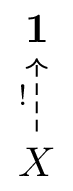
In category theory, a terminal object 1
is defined as “an object such that for every object X,
there is exactly one morphism from X to 1.” It
serves as an “endpoint” representing an object with no information (or
containing only one value). The unique morphism is written as
!.
Visually, this corresponds to the following situation:
Correspondences to programming concepts:
() type (unit type)void or unit types in other languagesNow, let’s define the terminal object in CPL. Using the
edit command, enter multi-line editing mode, input your
data type definition, and exit multi-line editing mode by entering
semicolon ;.
cpl> edit
| right object 1 with !
| end object;
right object 1 defined
The output “right object 1 defined” confirms that the
terminal object 1 has been successfully defined.
Detailed information about a defined object can be viewed using
show object.
cpl> show object 1
right object 1
- natural transformations:
- factorizer:

    ----------
    !: *a -> 1
- equations:
    (RFEQ): 1=!
    (RCEQ): g=!
- unconditioned: yes
- productive: ()
When object 1 is defined, a special morphism ! is also
defined from any object to the terminal object.
The show command can also be used to display the
morphism’s type (domain and codomain). Here, *a is a
variable representing an object, so this represents an morphism from any
object to the terminal object 1.
cpl> show !
!
: *a -> 1Next, we’ll define the product. The product combines two objects into a single object.
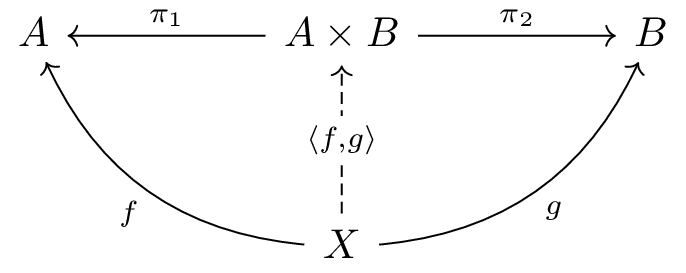
In category theory, the product A × B
(prod(a,b) in CPL) is defined as “an object that preserves
the information of both objects A and B.” It
satisfies the following properties:
π₁: A × B → A and
π₂: A × B → BX with morphisms f: X → A
and g: X → B to A and B
respectively, there exists a unique morphism
⟨f,g⟩: X → A × B such that π₁ ∘ ⟨f,g⟩ = f and
π₂ ∘ ⟨f,g⟩ = g (this kind of property is referred to as the
universal property).Visually represented as a diagram:
Correspondences with programming concepts:
(a, b) type (tuple)Now, let’s define the product in CPL:
cpl> edit
| right object prod(a,b) with pair is
|   pi1: prod -> a
|   pi2: prod -> b
| end object;
right object prod(+,+) defined
(Note in the definition of pi1 and pi2 that
the object prod we’re defining now lacks arguments. The
mearning is “Among all x equipped with
x -> a and x -> b, we define the most
general x as prod(a,b),” but reusing the name
prod instead of introducing a new name x)
Unlike in the case of terminal objects, the product
prod(a,b) is an object that takes parameters, and the
resulting definition displays as prod(+,+). The
+ indicates covariance, and we can see that
prod takes two arguments and is covariant with respect to
both arguments. Use show object to display detailed
information.
cpl> show object prod
right object prod(+,+)
- natural transformations:
    pi1: prod(*a,*b) -> *a
    pi2: prod(*a,*b) -> *b
- factorizer:
    f0: *a -> *b  f1: *a -> *c
    ------------------------------
    pair(f0,f1): *a -> prod(*b,*c)
- equations:
    (REQ1): pi1.pair(f0,f1)=f0
    (REQ2): pi2.pair(f0,f1)=f1
    (RFEQ): prod(f0,f1)=pair(f0.pi1,f1.pi2)
    (RCEQ): pi1.g=f0 & pi2.g=f1 => g=pair(f0,f1)
- unconditioned: yes
- productive: (yes,yes)
Unlike terminal objects, in the case of products, both projection
morphisms pi1 and pi2 are defined
simultaneously (you can also check their types using the
show command).
Additionally, a function (factorizer) pair is also
defined, which constructs pair(f,g): a -> prod(b,c) from
f: a -> b and g: a -> c. The morphism
previously written as ⟨f,g⟩ is now written as
pair(f,g) in this definition of products in CPL. The
factorizer pair itself is not an morphism and cannot be
displayed using show; instead, use
show function to display its type.
cpl> show function pair
f0: *a -> *b  f1: *a -> *c
------------------------------
pair(f0,f1): *a -> prod(*b,*c)
Furthermore, while prod maps objects a and
b to the object prod(a,b), it also maps
morphisms f: a -> c and g: b -> d to
prod(a,b) -> prod(b,d). In category theory, a
functor maps objects to objects and morphisms between
objects to morphisms between mapped objects. Using
show function prod, you can verify the type of
prod’s action on morphisms.
cpl> show function prod
f0: *a -> *c  f1: *b -> *d
---------------------------------------
prod(f0,f1): prod(*a,*b) -> prod(*c,*d)
Furthermore, examining equations reveals that the
following four equalities hold. Here, the . notation
represents morphism composition, meaning
g.f means “first apply f, then apply
g” (corresponding to the mathematical notation
g ∘ f).
pi1.pair(f0,f1)=f0
pi2.pair(f0,f1)=f1
prod(f0,f1)=pair(f0.pi1,f1.pi2)
prod in terms of pair and
pi1, pi2)pi1.g=f0 & pi2.g=f1 => g=pair(f0,f1)
g satisfies the same conditions as
pair(f0,f1), then g=pair(f0,f1), i.e.,
pair(f0,f1) is unique)Next, we define the exponential object, which is a structure for treating functions as values.
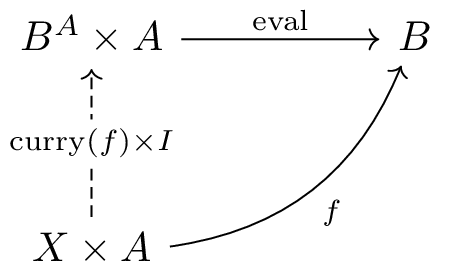
The exponential object Bᴬ (denoted as
exp(a,b) in CPL) represents “the object that encodes all
morphisms from A to B.” It possesses the
following properties:
eval: Bᴬ × A → B exists,
allowing functions to be applied to values
eval here, in functional programming
contexts, apply would be a more natural name)f: X × A → B, there exists a unique
curried morphism curry(f): X → Bᴬ satisfying
eval ∘ (curry(f) × I) = f
I: A → A represents the identity morphism, and
× denotes the product morphism operation)Visualized as a diagram, it appears as follows:
Why Is the Exponential Object Called a “Function Space”? Let’s consider this concretely in the context of the category of sets.
Bᴬ is the set
{f | f: A → B} of functions itself.eval(f, a) = f(a). In other words, it performs the
operation of “taking a pair of a function f and its
argument a, and returning the result of applying
f to a.”f: X × A → B, curry(f)(x) returns the function
a ↦ f(x, a). In other words, currying transforms a
two-argument function into a one-argument function that returns another
function — this is precisely the operation of converting a function into
a function that returns functions.X × A → B are in one-to-one correspondence with functions
from X → Bᴬ” — is what uniquely characterizes
Bᴬ as a function space. This correspondence is exactly the
relationship between currying and function application in
programming.Correspondences with programming concepts:
a -> b type (function type)A category equipped with the terminal object, product objects, and exponential objects is called a Cartesian Closed Category, which forms the theoretical foundation for lambda calculus and functional programming.
Now, let’s define the exponential object in CPL:
cpl> edit
| right object exp(a,b) with curry is
|   eval: prod(exp,a) -> b
| end object;
right object exp(-,+) defined
We can display detailed information using
show object:
cpl> show object exp
right object exp(-,+)
- natural transformations:
    eval: prod(exp(*a,*b),*a) -> *b
- factorizer:
    f0: prod(*a,*b) -> *c
    ---------------------------
    curry(f0): *a -> exp(*b,*c)
- equations:
    (REQ1): eval.prod(curry(f0),I)=f0
    (RFEQ): exp(f0,f1)=curry(f1.eval.prod(I,f0))
    (RCEQ): eval.prod(g,I)=f0 => g=curry(f0)
- unconditioned: yes
- productive: (no,no)
We can see that eval for function application,
curry for currying, and the conditions for an exponential
object in category theory are all defined.
Let’s examine how the functor exp operates on morphisms
using show function:
cpl> show function exp
f0: *c -> *a  f1: *b -> *d
------------------------------------
exp(f0,f1): exp(*a,*b) -> exp(*c,*d)
Note the directionality of the argument morphisms, and how the
parameters of exp change from domain to codomain in the
result:
f0 is a morphism from *c to
*a, but the parameter changes direction from
*a to *c in the resultf1 is a morphism from *b to
*d, and the direction of the parameter is the same, from
*b to *dThis indicates that exp is a contravariant functor with
respect to the first argument and a covariant functor with respect to
the second argument. The notation exp(-,+) used during
definition and in show object exp is a concise
representation of this property.
A natural numbers object is an inductively defined structure characterized by the number 0 and the successor function.
The natural numbers object ℕ is uniquely characterized
by the following elements:
0: 1 → ℕ (the initial value)s: ℕ → ℕ (also denoted as
succ, the function that increments by 1)X and morphisms z: 1 → X
and f: X → X, there exists a unique morphism
pr(z,f): ℕ → X defined recursively such that
pr(z,f) ∘ 0 = z and
pr(z,f) ∘ s = f ∘ pr(z,f)This pr operation corresponds to mathematical
induction and serves as the fundamental method for defining
functions over the natural numbers.
Visualized graphically, this structure appears as follows:
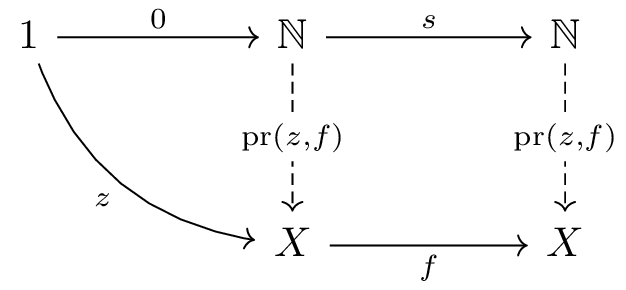
Please note the direction of the arrows. Whereas in the terminal objects, products, and exponential objects we have handled so far, there existed a unique morphism with that object as its codomain, in the case of the natural numbers object, conversely, there exists a unique morphism with that object as its domain.
Correspondences to programming concepts:
The definition of natural numbers according to Peano’s axioms
Equivalent to Haskell data types such as:
data Nat = Zero | Succ NatRecursive computations (folding)
Now, let’s define the natural numbers object in CPL. While we have
previously defined objects as right objects when there
exists a unique morphism with that object as their codomain, we
now define the natural numbers object as left object as
there exists a unique morphism with that object as their
domain:
cpl> edit
| left object nat with pr is
|   0: 1 -> nat
|   s: nat -> nat
| end object;
left object nat defined
To display the defined information, use
show object nat:
cpl> show object nat
left object nat
- natural transformations:
    0: 1 -> nat
    s: nat -> nat
- factorizer:
    f0: 1 -> *a  f1: *a -> *a
    -------------------------
    pr(f0,f1): nat -> *a
- equations:
    (LEQ1): pr(f0,f1).0=f0
    (LEQ2): pr(f0,f1).s=f1.pr(f0,f1)
    (LFEQ): nat=pr(0,s)
    (LCEQ): g.0=f0 & g.s=f1.g => g=pr(f0,f1)
- unconditioned: no
- productive: ()
Here, 0 and s represent the zero and
successor functions respectively, while pr corresponds to
mathematical induction, along with the conditions they must satisfy.
The coproduct is a structure representing “either-or,” serving as the dual concept to the direct product.
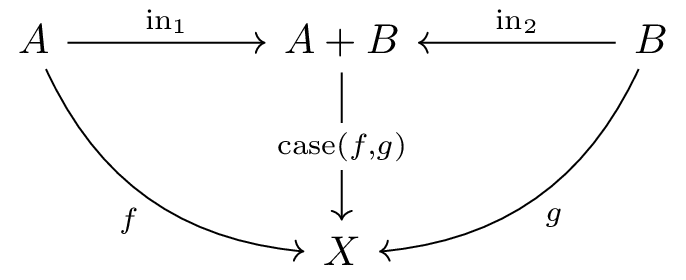
The coproduct A + B (denoted as coprod(a,b)
in CPL) is an object that can hold one of two values, either from object
A or B:
in₁: A → A + B and
in₂: B → A + B (which “inject” values into the
coproduct)X and morphisms f: A → X
and g: B → X, there exists a unique morphism
case(f,g): A + B → X that combines them case-by-case,
satisfying case(f,g) ∘ in₁ = f and
case(f,g) ∘ in₂ = gThis is the dual concept of the product, obtained by “reversing the arrow,” and serves as a good example of symmetry in category theory.
Visualized graphically, it appears as follows: (Compare with the product diagram to verify that morphisms are reversed):
Correspondences to programming concepts:
Either a b typevariant types or other languages’ union
types with tagsNow let’s define the coproduct in CPL:
cpl> edit
| left object coprod(a,b) with case is
|   in1: a -> coprod
|   in2: b -> coprod
| end object;
left object coprod(+,+) defined
cpl> show object coprod
left object coprod(+,+)
- natural transformations:
in1: *a -> coprod(*a,*b)
in2: *b -> coprod(*a,*b)
- factorizer:
f0: *b -> *a f1: *c -> *a
--------------------------------
case(f0,f1): coprod(*b,*c) -> *a
- equations:
(LEQ1): case(f0,f1).in1=f0
(LEQ2): case(f0,f1).in2=f1
(LFEQ): coprod(f0,f1)=case(in1.f0,in2.f1)
(LCEQ): g.in1=f0 & g.in2=f1 => g=case(f0,f1)
- unconditioned: yes
- productive: (no,no)The show command can be used to display the types of
morphisms (their domains and codomains).
cpl> show pair(pi2,eval)
pair(pi2,eval)
    : prod(exp(*a,*b),*a) -> prod(*a,*b)
Here, *a and *b are variable ranging over
objects, and the morphism actually denotes families of morphisms with
varying types (domains and codomains). When these families satisfy
certain conditions, they are called natural
transformations, which correspond to polymorphic
functions in typical functional programming languages.
In the above example, pair(pi2,eval) is an morphism that
works for any objects *a and *b, and can be
viewed as a natural transformation from the functor
F(*a,*b) = prod(exp(*a,*b),*a) to the functor
G(*a,*b) = prod(*a,*b).
The . symbol appearing in the equations above refers to
fundamental operations on morphisms, which we will now review.
. represents morphism composition.
Given morphisms f: A → B and g: B → C, the
composed morphism g.f: A → C is the morphism that “first
applies f, then applies g”. This corresponds
to the mathematical notation g ∘ f (the Unicode symbol
∘ is also usable in CPL).
For example, we can represent natural numbers by composing the
successor function s: nat → nat with the zero
0: 1 → nat:
cpl> show s.0
s.0
    : 1 -> nat
cpl> show s.s.s.0
s.s.s.0
    : 1 -> nat
s.s.s.0 represents the “morphism obtained by composing
s (successor function) three times with 0”,
which corresponds to the natural number 3. Similarly,
s.s.0 represents 2, and s.0
represents 1.
The identity morphism I is the
“do-nothing” morphism, with I: A → A existing for any
object A:
cpl> show I
I
    : *a -> *a
An identity morphism satisfies f.I = f and
I.f = f. While it may seem trivial at first glance, we
frequently use it in conjunction with functors to “transform only one of
the components while leaving the other unchanged”:
cpl> show prod(s, I)
prod(s,I)
    : prod(nat,*a) -> prod(nat,*a)
Here, prod(s, I) represents the morphism that “applies
s to the first component of the product while leaving the
second component unchanged.”
The let command allows us to assign names to morphisms,
enabling subsequent reference by name. This enables us to construct
complex morphisms step by step.
As our first example, let’s define the natural number addition
add: prod(nat, nat) → nat. This would be a function
typically written as follows:
add 0 y = y
add (x + 1) y = add x y + 1
In CPL, we express this using primitive recursion pr
combined with currying curry. Let’s break it down step by
step.
Strategy: We want to use primitive recursion
pr on the first argument, but
pr(f0, f1): nat → X can only define unary morphisms.
Therefore, we curry the second argument by
encapsulating it within the exponential object.
Curried addition add':
add': nat → exp(nat, nat) — An morphism that takes a
natural number n and returns a “function that adds
n”pr(f0, f1)f0 = curry(pi2) (zero case):
add'(0) returns “the function that adds 0” = the
identity functionpi2: prod(1, nat) → nat is an morphism that extracts
the second component of a product, which here functions as “discarding
the first component (the unique value of the terminal object) while
returning the second argument unchanged”curry(pi2): 1 → exp(nat, nat) serves as the base case
for the zero casef1 = curry(s.eval) (successor
case):
add'(n+1) returns “a function that applies
s to the result of add'(n)”eval: prod(exp(nat,nat), nat) → nat represents function
applications.eval: prod(exp(nat,nat), nat) → nat performs
“function application followed by taking the successor”curry(s.eval): exp(nat,nat) → exp(nat,nat) represents
the recursive stepUncurrying: Revert
add' = pr(curry(pi2), curry(s.eval)) back to
eval and prod:
prod(add', I): prod(nat, nat) → prod(exp(nat,nat), nat)
— Applies add' to the first argumenteval.prod(add', I): prod(nat, nat) → nat — Applies the
resulting function to the second argumentPutting it all together:
cpl> let add=eval.prod(pr(curry(pi2), curry(s.eval)), I)
add : prod(nat,nat) -> nat  defined
In the let construct, we can also define morphisms with
parameters.
cpl> let uncurry(f) = eval . prod(f, I)
f: *a -> exp(*b,*c)
-----------------------------
uncurry(f): prod(*a,*b) -> *cIn CPL, computation is performed through simplification of morphism
expressions using the simp command. Let’s simplify an
morphism using our previously defined addition function
add.
cpl> simp add.pair(s.s.0, s.0)
s.s.s.0
    : 1 -> nat
The result s.s.s.0 represents applying the successor
function s three times, corresponding to the natural number
3. This demonstrates the calculation 2 + 1 = 3.
Similar to addition, let’s define and compute multiplication and factorial.
Multiplication
mult: prod(nat, nat) → nat can be defined using the same
pattern as addition (currying + primitive recursion + uncurrying):
cpl> let mult=eval.prod(pr(curry(0.!), curry(add.pair(eval, pi2))), I)
mult : prod(nat,nat) -> nat
The differences from add lie only in the zero case and
the recursive step:
curry(0.!) —
0 × y = 0 (0.! is an morphism that returns
zero regardless of input)curry(add.pair(eval, pi2)) —
(n+1) × y = n × y + y (adds the recursive result
eval to y itself pi2)Factorial fact: nat → nat uses a
slightly different approach. It carries the state of
prod(nat, nat) (a pair of accumulator and counter) using
pr:
cpl> let fact=pi1.pr(pair(s.0,0), pair(mult.pair(s.pi2,pi1), s.pi2))
fact : nat -> nat definedpair(s.0, 0) —
(1, 0), i.e. “0! = 1, counter = 0”pair(mult.pair(s.pi2, pi1), s.pi2) — computes
(acc, k) to ((k+1) × acc, k+1)pi1 extracts the
accumulator value (the factorial result)Let’s compute it:
cpl> simp fact.s.s.s.s.0
s.s.s.s.s.s.s.s.s.s.s.s.s.s.s.s.s.s.s.s.s.s.s.s.0
    : 1 -> nat
Since s has been applied 24 times, we obtain the correct
result 4! = 24.
Next, we’ll define a list type—a data structure that’s very similar to natural numbers but slightly more complex.
Lists, like natural numbers, have an inductive structure, but they differ in that lists are parameterized by their element type:
nil: 1 → list(a)cons: a × list(a) → list(a) (adds an
element to the front)prl(z,f): list(a) → b for recursively processing
listsVisualized graphically:
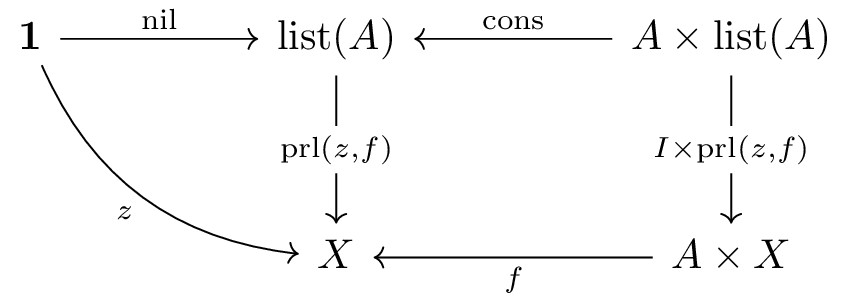
This represents a classic example of an inductive data type that describes finite structures.
Correspondence with programming:
[a] type (lists)foldrNow let’s define lists in CPL:
cpl> edit
| left object list(p) with prl is
|   nil: 1 -> list
|   cons: prod(p,list) -> list
| end object;
left object list(+) defined
cpl> show function list
f0: *a -> *b
------------------------------
list(f0): list(*a) -> list(*b)
cpl> show object list
left object list(+)
- natural transformations:
nil: 1 -> list(*a)
cons: prod(*a,list(*a)) -> list(*a)
- factorizer:
f0: 1 -> *a f1: prod(*b,*a) -> *a
----------------------------------
prl(f0,f1): list(*b) -> *a
- equations:
(LEQ1): prl(f0,f1).nil=f0
(LEQ2): prl(f0,f1).cons=f1.prod(I,prl(f0,f1))
(LFEQ): list(f0)=prl(nil,cons.prod(f0,I))
(LCEQ): g.nil=f0 & g.cons=f1.prod(I,g) => g=prl(f0,f1)
- unconditioned: no
- productive: (no)The list is also a parameterized object, that is, a functor. Let’s
examine its action on morphisms. In functional programming, this action
of the list functor on morphisms is often referred to as
map.
cpl> show function list
f0: *a -> *b
------------------------------
list(f0): list(*a) -> list(*b)
Next, let’s express some familiar functions using the list type.
Concatenation (append):
cpl> let append = eval.prod(prl(curry(pi2), curry(cons.pair(pi1.pi1, eval.pair(pi2.pi1, pi2)))), I)
append : prod(list(*a),list(*a)) -> list(*a)  defined
Reversal (reverse):
cpl> let reverse=prl(nil, append.pair(pi2, cons.pair(pi1, nil.!)))
reverse : list(*a) -> list(*a)  defined
head / tail:
cpl> let hd = prl(in2, in1.pi1)
hd : list(*a) -> coprod(*a,1)  defined
cpl> let tl = coprod(pi2,I).prl(in2, in1.prod(I, case(cons,nil)))
tl : list(*a) -> coprod(list(*a),1)  defined
We’ve chosen hd / tl here because we want
to use these names when working with infinite lists later. In CPL, since
only total functions exist and no partial functions are allowed, the
codomain is a coproduct with 1 (equivalent to the
Maybe or Option types in other languages).
For convenience, we’ve also defined versions that lift the domain to
the coproduct with 1, allowing us to apply
head / tail to the results of these operations
again.
cpl> let hdp=case(hd,in2)
hdp : coprod(list(*a),1) -> coprod(*a,1)  defined
cpl> let tlp = case(tl, in2)
tlp : coprod(list(*a),1) -> coprod(list(*a),1)  defined
Sequential numbers [n-1, n-2, ..., 1, 0]:
cpl> let seq = pi2.pr(pair(0,nil), pair(s.pi1, cons))
seq : nat -> list(nat)  defined
Now, let’s perform some computations.
Some calculations require simp full instead of just
simp to proceed with reduction.
cpl> simp seq.s.s.s.0
cons.pair(s.pi1,cons).pair(s.pi1,cons).pair(0,nil)
    : 1 -> list(nat)
cpl> simp full seq.s.s.s.0
cons.pair(s.s.0,cons.pair(s.0,cons.pair(0,nil)))
    : 1 -> list(nat)
While simp alone stops at an intermediate form,
simp full completes the full reduction. The result
cons.pair(s.s.0,cons.pair(s.0,cons.pair(0,nil))) represents
list notation in CPL. In other languages, this corresponds to the list
[2, 1, 0]:
| CPL Representation | Meaning |
|---|---|
nil |
[] (Empty list) |
cons.pair(x, xs) |
x : xs (Prepend x to the beginning of
xs) |
cons.pair(s.s.0, cons.pair(s.0, cons.pair(0, nil))) |
[2, 1, 0] |
Let’s examine the results of computing with other functions as well:
cpl> simp hdp.tl.seq.s.s.s.0
in1.s.0
    : 1 -> coprod(nat,*a)
Since seq.s.s.s.0 equals [2, 1, 0],
applying tl to remove the head yields [1, 0],
and then applying hdp to get the head results in
in1.s.0 (which equals Just 1).
cpl> simp full append.pair(seq.s.s.0, seq.s.s.s.0)
cons.pair(s.0,cons.pair(0,cons.pair(s.s.0,cons.pair(s.0,cons.pair(0,nil)))))
    : 1 -> list(nat)
cpl> simp full reverse.it
cons.pair(0,cons.pair(s.0,cons.pair(s.s.0,cons.pair(0,cons.pair(s.0,nil.!)))))
    : 1 -> list(nat)
append.pair(seq.s.s.0, seq.s.s.s.0) concatenates
[1, 0] and [2, 1, 0] to form
[1, 0, 2, 1, 0], while reverse.it reverses
this to produce [0, 1, 2, 0, 1].
In the final example simp full reverse.it, we use
it to reference the result of the previous computation
(append.pair(seq.s.s.0, seq.s.s.s.0)). it is a
useful feature that automatically stores the result of the immediately
preceding simp command.
simp and simp fullCPL provides two reduction commands:
simp: Performs basic reduction. Fast
but may stop prematurelysimp full: Performs more thorough
reduction. Use when a completely reduced form is requiredIn addition to finite data types like natural numbers and lists, we can also define data types for infinite lists.
Unlike finite lists, infinite lists are defined as a
right object. This is an example of a coinductive
data type:
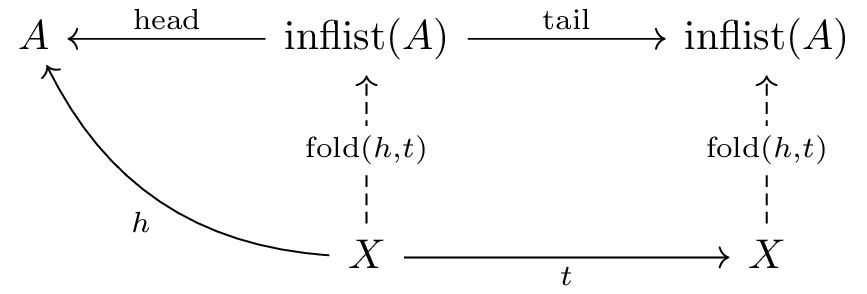
head: inflist(a) → a (extracts the head element)tail: inflist(a) → inflist(a) (obtains the remaining
infinite list)fold(h,t): x → inflist(a) allows unfolding the infinite
list (note that while named fold, in modern functional
programming conventions this would more appropriately be called
unfold)While finite lists operate by “building up and then consuming,” infinite lists have the contrasting structure of “unfolding from state.”
Visualized graphically:
Corresponding to programming concepts:
unfoldNow let’s define an infinite list in CPL.
cpl> edit
| right object inflist(a) with fold is
|   head: inflist -> a
|   tail: inflist -> inflist
| end object;
right object inflist(+) defined
cpl> show object inflist
right object inflist(+)
- natural transformations:
head: inflist(*a) -> *a
tail: inflist(*a) -> inflist(*a)
- factorizer:
f0: *a -> *b f1: *a -> *a
------------------------------
fold(f0,f1): *a -> inflist(*b)
- equations:
(REQ1): head.fold(f0,f1)=f0
(REQ2): tail.fold(f0,f1)=fold(f0,f1).f1
(RFEQ): inflist(f0)=fold(f0.head,tail)
(RCEQ): head.g=f0 & tail.g=g.f1 => g=fold(f0,f1)
- unconditioned: no
- productive: (no)Now, let’s define and compute with morphisms using infinite lists.
First, we create an ascending sequence 0, 1, 2, 3, …:
cpl> let incseq=fold(I,s).0
incseq : 1 -> inflist(nat)  defined
fold(I,s) represents the unfolding rule that “outputs
the current state as the head (I), then
applies s to the state to proceed.” Starting from the
initial state 0, this produces the infinite sequence 0, 1,
2, 3, …
cpl> simp head.incseq
0
    : 1 -> nat
cpl> simp head.tail.tail.tail.incseq
s.s.s.0
    : 1 -> nat
We can extract the first element 0 using head, and the
fourth element 3 using head.tail.tail.tail.
Next, we define the alt function that alternates between
two infinite lists:
cpl> let alt=fold(head.pi1, pair(pi2, tail.pi1))
alt : prod(inflist(*a),inflist(*a)) -> inflist(*a)  defined
alt uses the product prod(inflist, inflist)
as its state, with head.pi1 outputting the head of the
first list, and pair(pi2, tail.pi1) swapping the roles of
the two lists (outputting the second list first, followed by the first
list’s tail).
cpl> let infseq=fold(I,I).0
infseq : 1 -> inflist(nat)  defined
cpl> simp head.tail.tail.alt.pair(incseq, infseq)
s.0
    : 1 -> nat
infseq is a constant sequence 0, 0, 0, … The expression
alt.pair(incseq, infseq) produces an alternating sequence
0, 0, 1, 0, 2, 0, 3, … Therefore, the third element (index 2 starting
from 0) is s.0 (= 1).
When defining data types in CPL, there are two types of declarations:
left object and right object. This reflects
the important concept of duality in category
theory.
A right object is a structure based on
limits in category theory. Limits are characterized by
their property of being “defined by incoming morphisms
from other objects.”
1: The unique morphism !
from any object to 1prod(a,b): Creates morphism
pair(f,g): x -> prod(a,b) from two morphisms
f: x -> a and g: x -> bexp(a,b): Creates morphisms through
curryinginflist: Expands infinite structures
using foldA left object is a structure based on
colimits in category theory. Colimits are characterized
by their property of being “defined by outgoing
morphisms from this object to others.”
nat: Consumes (folds) natural numbers
defined recursively by prcoprod(a,b): Branches into two cases using
caselist: Folds recursive list structures using
prlGeneral guidelines:
left object (constructed recursively)right object (expanded corecursively)However, the symmetry between left and right in category theory is profound, and being able to experience this duality while using CPL is one of the language’s key features.
This left/right distinction corresponds to the following:
| CPL | Category Theory | Property |
|---|---|---|
| right object | Limit, Right adjoint, F-coalgebra | Unifies “incoming” morphisms via universal morphisms |
| left object | Colimit, Left adjoing, F-algebra | Unifies “outgoing” morphisms via couniversal morphisms |
In CPL, these concepts are treated symmetrically, allowing you to learn how category theory concepts are applied in practical programming.
Through this tutorial, you’ve learned both the basic usage of CPL and fundamental category theory concepts.
CPL usage:
edit,
show, let, simp, etc.)left object and right objectCategory theory concepts:
right object and left objectIn CPL, structures that would typically be “built-in” in other programming languages (such as numbers, lists, and functions) are all explicitly defined using category theory concepts. This results in:
To deepen your understanding of CPL, we recommend trying the following:
samples/ directory contains various program
examplesload “samples/examples.cpl”samples/ack.cpl)We hope this tutorial serves as your first introduction to the world of CPL and category theory. Happy programming!